Dear fellow “Nature” Substackers,
I have a question for you.
But first, I very strongly suspect that many of us who hike and explore our environs share a secret relationship with a special tree. That is, a tree that has personal meaning to us.
A tree that we first met perhaps many years ago, and that we bonded with. That we return to for comfort, habit, or merely for its presence. And a tree that we therefore feel in some way partnered with, even if logic tells us that the connection runs a bit one-way.
But we’re not talking about the logical mind or rationalism here. Rather, we’re talking about a core reason why we hike and enter nature.
I have such a tree. This is it, below.
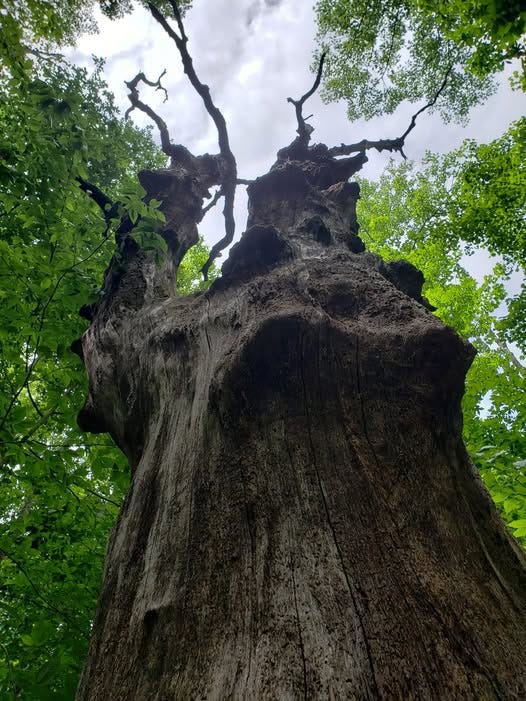
As you’ll immediately notice, “my” tree is long dead. It’s what’s called a snag. We know it continues to support surrounding life in many important ways. But it’s own life — in the conventional sense — ended some years ago. In this tree’s case, I suspect, some decades ago. It’s hard to imagine now that this stoic corpse was ever alive, much less a sapling. I certainly never knew it in that condition.
But this tree’s powerful presence drew me in from first glance. It reminded me of a recurring sense I’d felt as a child: the possibility that all the trees standing before us are themselves the root systems of a forest found in another, inverted world immediately below us. Each trunk or branch reaching towards the sky is really a taproot, anchoring the upside-down (to us) tree into our perceptual world. It was a thought-vision of an alternative world that, unbeknownst to us, existed just under our feet. Like some missing illustration from The Little Prince.
I pass by this “dead” tree regularly. It stands beside an unremarkable trail where other people see it, too. A hiker would need only 45 minutes on the trail to find it, if she were looking.
But I’ve never observed anyone else pause to take it in. Or, as I do, touch it, hug it, and say a few words of thanks. My tree ritual has by now evolved into something between a habit, a tic, a prayer, and a superstition.
And I ask this tree to take care of the people I love. After making certain no one is watching, of course. I treat it like it’s a secret. Like we’re a secret.
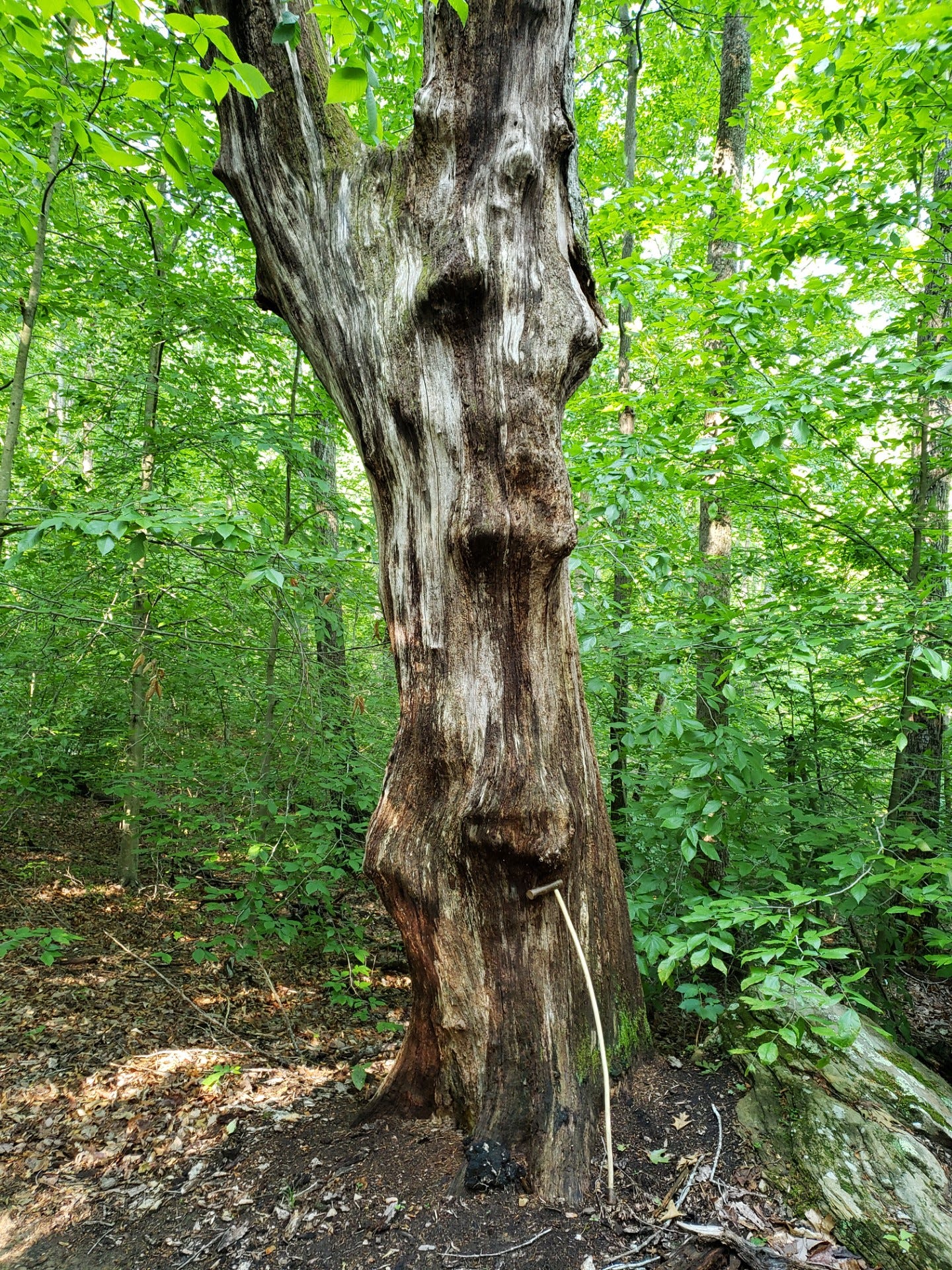
I would only bring a most special friend to meet my tree. If I tried to explain its significance and my “relationship” to this dead tree to most people — even fellow hikers and naturalists — I’m afraid they’d think I’ve gone bonkers. Or just look at me differently from then on.
Such presences recover the suppressed animist in all of us. There are no atheists in foxholes, they say. In the forest, we nature lovers all become mystics.
My question to you, then: What do you call “your” tree?Here, I don’t mean a name, like Gertrude or Raymond. I mean something more like a title. An honorific.
“Spirit” tree, “totem” tree, something like that…
Please let me know in comments below. You are all dear to me.
I’ll finish with a poem by the late Laura Gilpin.
IV.
The things I know:
how the living go on living
and how the dead go on living with themSo that in a forest
even a dead tree casts a shadow
and the leaves fall one by one
and the branches break in the wind
and the bark peels off slowly
and the trunk cracks
and the rain seeps in through the cracks
and the trunk falls to the ground
and the moss covers itand in the spring the rabbits find it
and build their nest inside
and have their young
and their young will live safely
inside the dead treeSo that nothing is wasted in nature
or in love.
Nothing is wasted in nature or in love.