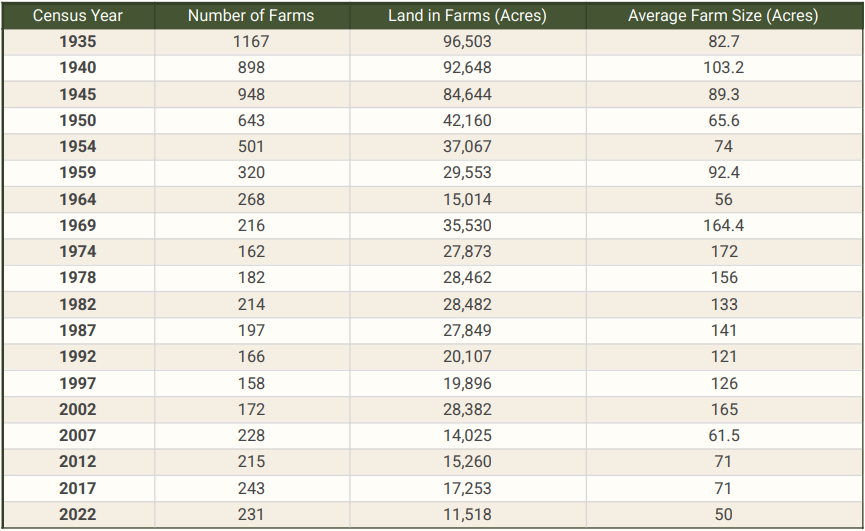
According to the same USDA Census of Agriculture, Stafford County specifically has lost a staggering 5,735 acres of farmland between 2017 and 2022. This is a 33% decrease from 17,253 acres down to 11,518 acres in just five years. The number of active farms in operation fell from 243 in 2017 to 231 in 2022, while the average size of our farms shrank by 30%, dropping from 71 acres to a mere 50 acres. I don't know about you, but I find these metrics absolutely terrifying.
At the beginning of 2026 when Supervisor Maya Guy asked if I wanted to serve on the Stafford County Agricultural and Land Conservation (ALC) Committee I was extremely honored and excited. I had no idea what was in store for me as the year progressed and the meetings began. The next thing I know was unexpectedly appointed as the Chairman and I've been learning all kinds of rich history and context on farming in our community from fellow committee members. When I first began, I viewed land conservation and agriculture and two separate topics. That has all completely changed.
Why is this happening?
There are several factors of Stafford County's dwindling farmlands including, but not limited to:
- Independent and family-owned farms being forced to shut down every year due to higher costs, debt, and bankruptcy.[3]
- Farmers facing high operating costs such as higher prices for feed, seed, fuel, fertilizer, etc.[4]
- Farms are continually forced to increase their prices for goods produced. This often comes at the loss of profit margins.
- Federal cuts by the Trump administration have resulted in significantly reduced funding availability for federal farm and conservation programs.[5]
The grim reality - farm acres are currently much more lucrative to sell off to land developers than to work and produce goods on.
Surely it will bounce back!
Some people may think this is a recent trend. It will bounce back, right? Unfortunately, historical USDA Census of Agriculture data shows that Stafford County has been in a overall decline since at least 1935. There was a period from 1969-1987 where things slightly rallied and flattened. This is largely accredited to the construction of Interstate 95 in the late 1960's and a subsequent influx in population in Stafford County. Instead of farmland being entirely lost to high-density tract housing, the economic pressures of this era caused large, historic family holdings to be actively subdivided into smaller, semi-commercial and residential-agricultural tracts. Immediately after 2002, the suburban housing boom of the mid-2000s took hold, leading directly to the massive 50.6% acreage collapse and severe land fragmentation that we see starting in the newly integrated 2007 census data.
Things have been in constant, regular decline ever since.
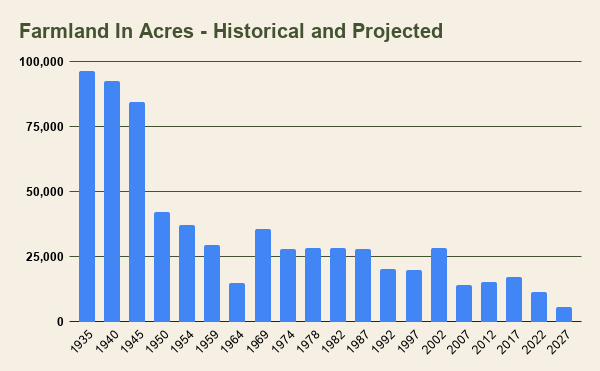
According to my projections based on historical data and trends, I estimate that Stafford County's active farmland in 2026 has dwindled to between 6,900 and 7,500 acres. This represents a catastrophic cumulative loss of approximately 60% of our agricultural acreage since 2017. Higher land values caused by sub-urbanization in Northern Virginia continue to tempt land owners to sell. The pressure has also shifted from typical tract-housing subdivisions to heavy industrial uses as the County is currently tracking at least 17 data center rezoning requests, which threaten to permanently swallow large, contiguous swathes of our A-1 Agricultural land. The projected 2027 Census data would put my estimate at only 5,783 acres of farmland remaining in the County.
But this must be happening everywhere, right?
Unfortunately it isn't. Stafford is a regional outlier compared to other high-pressure Northern Virginia counties. Stafford’s farmland loss rate (-33.0%) is about three times worse than Loudoun County (-10.0%) and Prince William County (-11.0%), and over six times worse than its stable southern neighbor, Spotsylvania County (-5.0%). Stafford is losing farmland five times faster than the Commonwealth of Virginia average (-6.4%) and fifteen times faster than the United States national average (-2.2%).
So where do we go from here?
If we want to ensure that Stafford County remains a community that values its rural heritage, environmental integrity, and food security, we need more formal support for the Virginia Right to Farm Act, formally declaring Stafford County a "Right to Farm" supportive community. We need to seriously review and amend local zoning and subdivision ordinances to ensure they are in strict conformity with VA Code § 3.2-301 and remove any administrative or regulatory barriers that unreasonably restrict farm structures, silviculture, or agricultural practices. We should continue funding conservation efforts through the Purchase of Development Rights (PDR) and Transfer of Development Rights (TDR) programs to provide landowners with viable financial alternatives to selling to industrial or residential developers. Finally, we need to educate residents and incoming developers that public services are extremely limited outside of the Urban Services Area and that active agricultural operations are protected under state law.
If this article resonates with you, you feel compelled to make a difference in our community, and/or you want your voice to be heard on this matter, I highly suggest you attend the next ALC meeting and engage in a conversation with the committee. Also, if you have any ideas on how we can save our farmlands, please drop them in the comments!
Conservation is a state of harmony between men and land. … Harmony with land is like harmony with a friend; you cannot cherish his right hand and chop off his left. That is to say, you cannot love game and hate predators; you cannot conserve the waters and waste the ranges; you cannot build the forest and mine the farm. The land is one organism.
Aldo Leopold
References
- https://www.science.org/doi/10.1126/science.aau6020 ↩
- https://www.nass.usda.gov/Publications/AgCensus/2022/ ↩
- https://capitolnewsillinois.com/news/a-real-farm-crisis-illinois-farm-bankruptcies-rise-for-3rd-straight-year/ ↩
- https://www.farmaid.org/issues/challenges-family-farmers-face/tracking-the-farm-economy-in-crisis/ ↩
- https://www.nytimes.com/2026/08/24/us/politics/farmers-federal-workers-exodus.html ↩